

I recently finished The Valley by Asher Emanuel, which was as good as everyone in New Zealand has been saying.* It’s a narrative journalism book about New Zealand’s criminal justice system, following three people – two defendants and their lawyer – through the ordinary ins and outs of the courts.
I was worried that I would be extremely envious as I read. I think that narrative longform journalism is THE coolest most aspirational form of writing, it is what I desperately want to do with my life and I have wanted for a long time. However, the topic was something I don’t know much about, and don’t feel at all interested in writing about personally. So instead I just had a really good time reading it, especially the dialogue; in all of the interviews it’s not always mentioned but there are lots of funny and absurd moments as well as sad ones. It is really wonderful that a document of Aotearoa like this exists.
Emanuel was interviewed by Toby Manhire, and was asked what other books he drew from while writing The Valley. He mentioned Evicted by Matthew Desmond, a wonderful work of sociology about housing insecurity, addiction and poverty in Milwaukee. Unfortunately for me, the conversation moved on before they talked about any other books that he had drawn on for The Valley.
I would place The Valley in a very specific subgenre – not just narrative non-fiction, but narrative reported non-fiction strictly about “ordinary people”, not big-deal politicians and decisionmakers, which is nonetheless extremely political – because it reveals how the decisions of the rich and powerful are felt by the poor. Ordinary people are more interesting than powerful people, because they are more likely to be honest; and this kind of long-term work, the methods of journalists and anthropologists is about revelation rather than surprise. I think this is one of the most human, compassionate ways to write, to give people lots of space to tell a story. On a personal level, as a reader, I think it is one of the best ways to develop compassion. And at the risk of revealing one of my most tender and dearly held dreams, this is exactly the kind of work I want to be doing. In my accounting of this genre, there are several aspects that define it:
- Following a few specific people through the details of their lives, rather than a lot of people
- Interviews over time, returning to the same people over years
- Relying primarily on interviews, rather than primary or secondary sources
- Being grounded in a topic; using people to illustrate a topic more fully
- As a result, being strongly oriented both in place and in time (when the reporting happened) while also illustrating broader themes
In an attempt to add to the conversation, here are some of my favourite books which are cousins of The Valley from all over the world.
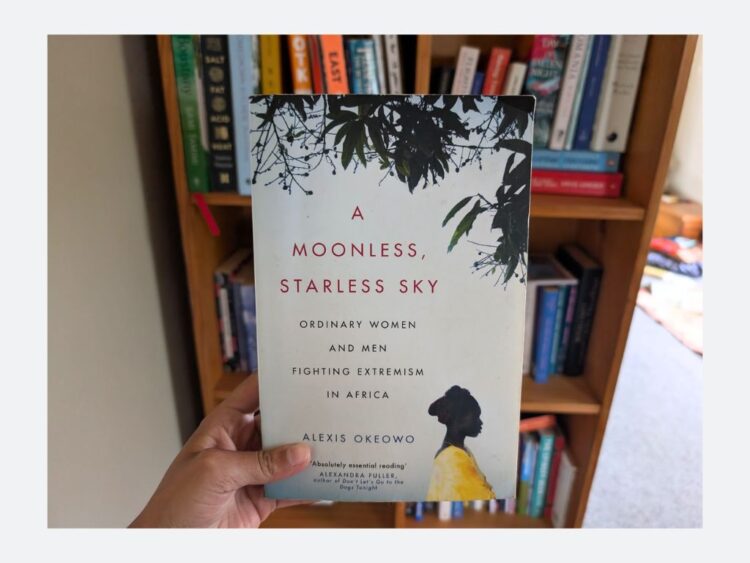
A Moonless, Starless Sky by Alexis Okeowo
The subtitle of this book is “ordinary men and women fighting extremism across Africa” which is a pretty accurate descriptor. It’s about the families of children kidnapped by Boko Haram; a basketball team having fun in Somalia; a couple who met in the Lord’s Resistance Army and are trying to build a new life now they are not forcibly kidnapped child soldiers. It’s about trauma, and work, but it’s also about hope. She doesn’t shy away from the complexity of, for example, the very recent practice of slavery in Mauritania and the way the people fighting Boko Haram start to think in similar stark lines. I read it in 2022 and am really due another read…
Karachi Vice by Samira Shackle
I was recently at a party where I met someone from Karachi and mentioned this book and I WAS AMAZED BECAUSE HE HAD READ THIS BOOK. We talked about how it represented Karachi and what it missed. It made me understand Karach in in particular, and dimensions of cities as a whole. Similar to other books on this list, Shackle follows five different people: an ambulance driver, a literacy activist, a urban planner, a reporter and a woman on the outskirts of the city where it is growing and expanding. I liked the sections about the ambulance driver (read a long-read version here) and the urban developer particularly, how there was a guerilla quality to how he traced what infrastructure people were already building in the absence of the state. Because I have also lived in informal communities in big South Asian cities this felt particularly easy to connect to. The bigger story is about violence in Karachi, and whether the city becomes more peaceful; the book is a little too pat on this (if you don’t read anything more about it that political thread feels quite resolved which it totally isn’t) but I understand the narrative compulsion to draw a bow over it.
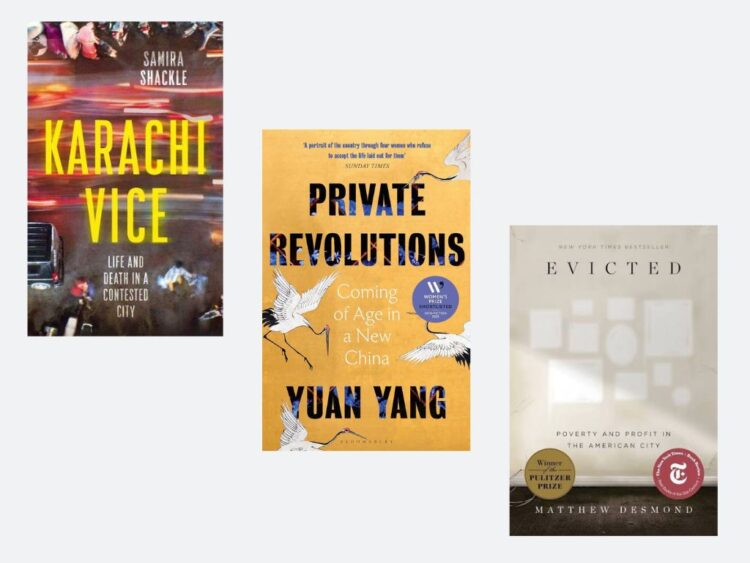
Private Revolutions by Yuan Yang
This is probably my favourite of the list, and it’s a real shame that Yang has become a backbench MP in the British Labour party instead of being a journalist (the best and most noble career). It’s about women in modern China. My favourite narratives are a migrant labourer in a factory who refuses to send her child to be raised by her parents in the village, so forms a collective with other factory workers who can all look after the kids on their days off. I also loved Sam, who ends up on the run for underground labour organising. The most revelatory part of it, as someone who is used to Western narratives about the lAcK Of DemOcrAcy in China, is how all four women Yang interviews are aware of the tradeoffs they have accepted in living in China. They know their government has issues! But their country is also their home. A friend has currently borrowed my copy of Private Revolutions and I want it back!
Evicted by Matthew Desmond
I read this when I was 19 in Hong Kong. That is more than eight years ago, so it speaks to the strength of the writing that I remember it really well. I especially lobed the parts where Desmond goes with people getting their methadone prescriptions and reveals what a hassle it is to try to get unaddicted (for good reason, but still!); and how he illuminates that it is not illogical for poor people to buy things like expensive TVs rather than paying their rent. It’s just a different framework: if housing has never been secure, why wouldn’t you pay for something that can be moved, even if doing so guarantees that you will have to move it? He writes about the rort of storage units for people who keep having to move, then he flips the compassion the other way by accompanying a landlord of many of the people in the story to show what it is like trying to provide housing to people in unstable situations. In the nature of the problems it is addressing – specifically of the very poor in a wealthy country – it has a lot in common with The Valley, and if you liked one you should read the other.
Similar to, but not exactly ordinary person narrative journalism
Strangers to Ourselves by Rachel Aviv
Aviv uses journalism but also draws extensively on written records and memoir for this book about the imprecision of mental illness, how it defies categorisation while shaping reality. What is the self, if the self is ill? Her documentation of a woman who has schizophrenia and runs away to Hindu temples, where she is considered devout and connected to god, rather than a threat to be medicated – is particularly compelling. She is an incredibly skilful writer.
We Cannot Live in the Sky by Mara Kardas Nelson
I mentioned this in a post earlier this year; Kardas Nelson’s topic is why the concept of “microloans” failed utterly to solve poverty. The heart of her book is interviews over several years with Sierra Leonian women taking out loans, trying to start businesses and pay interest. Honestly, this could have stood by itself; these women are clever and hardworking and funny. However, she splices it with interviews with Big Deal People (academics, NGOs, the Gates Foundation, USAID employees etc. etc.) to trace how the idea of microloans rose from the Grameen Bank into the Clinton presidency then into the predatory hands of private investment companies. Most evil of all is how she shows the impact of Mohammed Yunus’s idea that poor people can pay higher interest (as much as 100%!!) because they are more desperate.
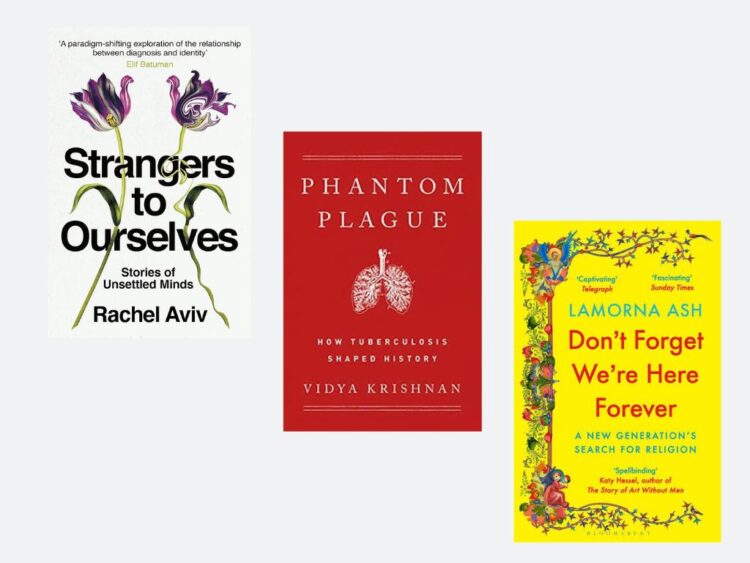
Phantom Plague by Vidya Krishnan
Vidya Krishnan wrote this history of tuberculosis several years before John Green tackled the subject and out of loyalty to Krishnan I can’t bring myself to read Everything is Tuberculosis. The best parts of the book are interviews with patients and their families in India and South Africa fighting for equitable access to tuberculosis drugs. In one compelling sequence, a father flies across the world to beg the pharmaceutical company for medication for his daughter. She still dies. Other parts of the book, like a section about a possible tubercular family killed in New England on suspicion of being vampires and descriptions about “chicken nuggets” felt like the American publisher wanted to shoehorn in more about white people and tuberculosis.
If We Burn by Vincent Bevins
I do get serious book loyalty because I am thinking about this book a lot and probably have mentioned it before. While it doesn’t have as strong a sense of individual characters, this book is splendidly reported, tracing protest movements (in Brazil, Chile, Hong Kong, Egypt, Turkey, Tunisia, South Korea, New York etc.) through the world in the 2010s. Why did this “mass protest decade” create so little lasting political change? Through interviews with people involved in movements around the world, Bevins suggests that “horizontalism” where protesters tried to organise their groups with no explicit leader to prefigure the society they wanted to bring into existence, often meant movements could not effectively negotiate, make decisions, or expel unwanted elements. I’m intrigued by how these ideas are picked up in Bevins’ more recent writing and publishing, such as this essay about the Serbian protests and the North South Notes website. I am thrilled that Bevins is going to tackle a history of advertising next!!
Don’t Forget We’re Here Forever by Lamorna Ash
This is the book on this list I have read most recently. In some ways it has more in common with “travel the world in search of a topic” journalism books (i.e. Becoming Earth; Water Always Wins), but it’s grounded by a specific interest in people, and has some elements of memoir. Ash is a wonderful writer who spends 2023 interviewing people about their experiences of conversion to Christianity, and in true anthropology style going to lots of retreats to see what it’s like to be within belief, or faith, whatever it is. I loved the interviews with people going to a queer church in Brighton; the descriptions of an Alpha course, and the Gerard Manley Hopkins of a silent Catholic retreat. I guess the Jesuits have just been on my mind lately (I also read The Sparrow). Ash isn’t interested in drawing hard lines about what Christianity is, but instead illuminates the sheer variety, and the strangeness, or religious practice. I found it tremendously inspiring as a journalist and a person who tries to believe (help my unbelief!). For a taster, read her Guardian Long Read (uh-oh sick with envy again) about two comedians who become priests.
*My tiny gripe about The Valley is that I think Emanuel overrelied on adverbs in his dialogue tags. Everyone is speaking quietly, pointedly, insistently, sadly, tiredly… some more description could have worked better even though the dialogue was great!
 Low-carbon adventure: Plain sailing
Leave a comment
Your email won't be published, but is used to retrieve your Gravatar.